

WinGo Big Small Basics
If you are new to wingo big small search terms, start with one clear definition: Big and Small are range outcomes tied to digits in short rounds. In common WinGo-style references, Small maps to 0–4 and Big maps to 5–9. That is the core mechanic most India searchers are trying to decode.
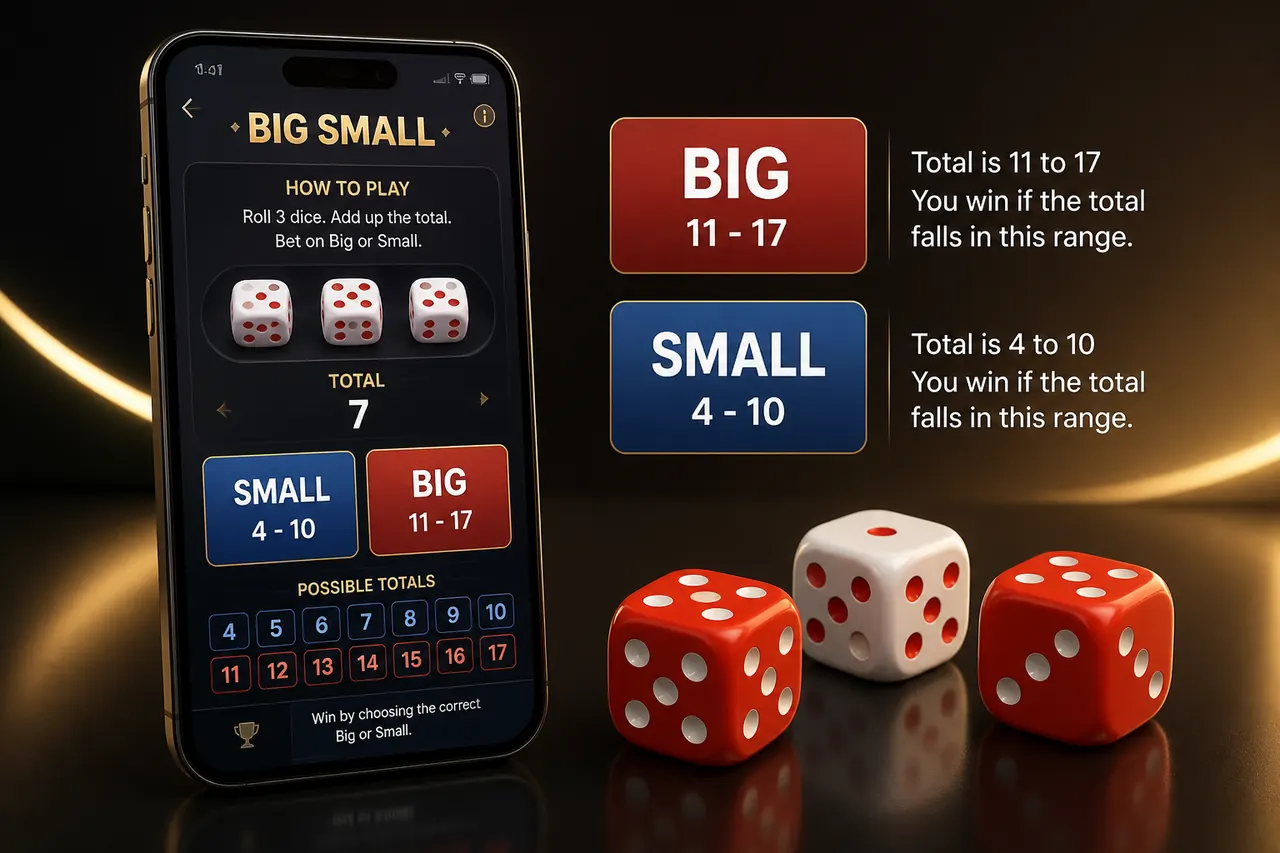
This is not the same math as Big Small Casino Royale on this site’s demo (3-dice sums 3–10 / 11–18). Keep the formats separate — see WinGo Big Small and how to play.
Confusion begins when people mix this core with extra claims about guaranteed prediction. Basics work best when stripped down: understand the round loop, read the strip correctly, and keep expectations realistic.
big small prediction guide
The round loop in plain language
A typical round has three visible phases: countdown, result reveal, and next-round reset. During countdown, users choose an outcome side. After countdown, a result is shown and written into a recent-history strip. Then the next period starts.
This rhythm is why Big Small feels fast. Decisions are short-cycle, and feedback is immediate. Speed can make the interface look easier than it really is, especially for first-time users. The better approach is to learn the loop slowly in demo mode before treating any sequence as meaningful.
big small prediction guide
Big and Small mapping
In common educational references:
- Small = 0, 1, 2, 3, 4
- Big = 5, 6, 7, 8, 9
This mapping explains why many strips display a single digit and then classify it into a side result. It also explains why color labels may appear nearby in some lobbies. Color context can exist, but Big/Small remains its own range decision.
The important part is not memorization alone. It is using the mapping without adding fake "hidden code" assumptions.
big small prediction guide
Reading result strips correctly
Result strips are useful records of completed rounds. They help users review what already happened and avoid memory bias. They do not confirm what must happen next.
New readers often make two errors:
- BTreating short streaks as guaranteed reversals.
- SIgnoring sample size while claiming pattern certainty.
Random sequences naturally produce clusters and streaks. Seeing a sequence is normal. Assuming it must continue or break at a specific moment is the risky jump.
big small prediction guide
Why history is reference, not prediction
History strips can teach pace and behavior. They cannot remove randomness from next-round outcomes. This distinction is central to responsible use of Big Small pages.
When people say "prediction," they may mean "observation-based guess." That is acceptable if framed honestly. The danger appears when guesswork is packaged as mathematical certainty and sold as a guaranteed method.
A practical mindset: use history to understand interface behavior and your own decisions, not to claim deterministic control.
big small prediction guide
Starter routine for first sessions
Keep your first learning sessions simple:
- BUse demo mode only.
- STrack ten to fifteen rounds maximum.
- BNote why you made each pick.
- SEnd on schedule, not on emotion.
- BReview decisions after the session, not mid-tilt.
This routine trains consistency. It also prevents "one more round" spirals that usually follow overconfidence.
big small prediction guide
Common myths beginners should ignore
- "After three Smalls, Big is guaranteed."
- "A screenshot can prove a permanent edge."
- "A private channel has fixed panel timing."
- "AI bot output is always superior to basic discipline."
Each myth shares the same issue: certainty without transparent, testable evidence. Ignore certainty claims and focus on process quality instead.
big small prediction guide
Practical closing note
WinGo Big Small basics are straightforward when explained without hype. Learn the range mapping, understand the round loop, read history as reference, and keep sessions controlled. If a source pushes guaranteed outcomes, it is no longer teaching basics. It is selling confidence theater.
FAQ
What do Big and Small usually mean?
In common format references, Small is 0-4 and Big is 5-9. Always check the visible rules in your current interface.
Is Big Small the same as color prediction?
They may appear in related lobbies, but Big/Small is a separate range decision. Do not merge categories blindly.
Can result history predict the next round?
History helps review completed rounds but does not guarantee next outcomes. Each round should be treated as independent.
Should I begin with real-money sessions?
Demo-first is safer for learning pace and controls. Start with short practice blocks before considering any stake.
What is the biggest beginner mistake?
Confusing streak visibility with certainty. Seeing a pattern is not the same as proving a reliable future signal.
By Anika Verma - Round Flow Editor