
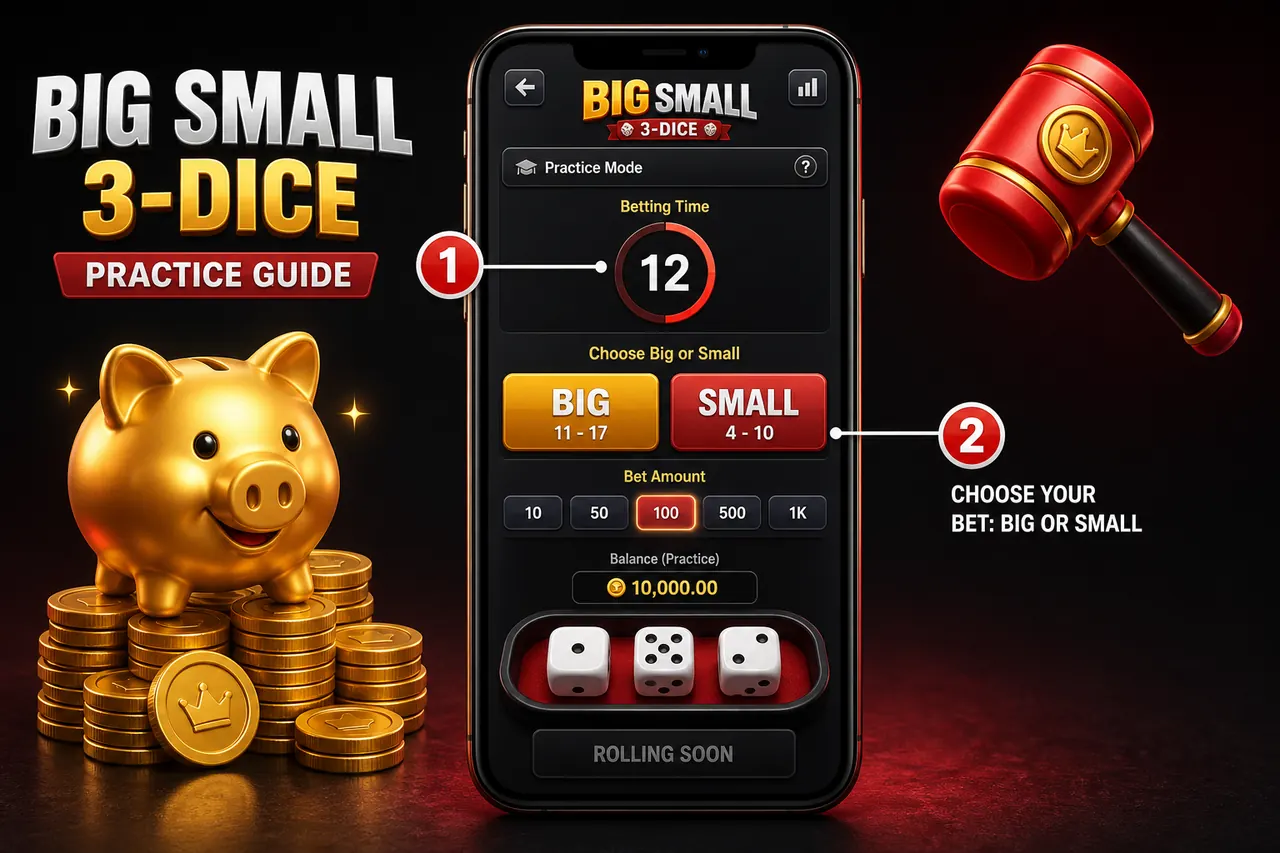

How to Play Big Small
This page is a practical how to play big small game flow: confirm the format map, use the timer, pick one side, log the result, then practise in demo before live stakes.
Disclaimer: each round is independent random. Past results do not guarantee the next outcome.
Step 1: Identify the format
| Lobby type | Small | Big | Typical clue |
|---|---|---|---|
| WinGo-style colour room | Digits 0–4 | Digits 5–9 | Single result digit 0–9, colour tiles |
| Casino Royale (this demo) | Sum 3–10 | Sum 11–18 | Three dice under a glass dome, 1.9X both sides |
If the mapping on screen does not match either table, do not stake until you understand settlement rules.
Step 2: Watch the round timer
- Read the round / period ID
- Check time remaining
- Confirm your pick only while the round is open
Late taps often fail after lock.
Step 3: Place one clear choice
Start with a single side — Big or Small — then wait for settlement before reacting. Avoid stacking random extras until the range logic is clear.
What Big Small is, in one paragraph
Big Small is a round game with one question: will the result land in the upper half or the lower half of its range? In colour rooms the result is a single digit — 0 to 4 is Small, 5 to 9 is Big, and the digit also carries a colour. On a 3-dice table the three dice are added — 3 to 10 is Small, 11 to 18 is Big. A round opens, a timer counts down, bets lock, and the result is drawn after the lock. Then the next period starts. That is the whole game; everything sold around it — predictors, signals, level plans — is added on top.
A quick check before every round
Before any pick, in the demo or anywhere else, run through four questions:
- Which map is this? Digit 0–9 or dice sum 3–18. The same word “Big” means different numbers.
- Is the round still open? Check the period number and the seconds left; taps after the lock do not count.
- What is the payout on each side? The 3-dice demo shows 1.9X on both sides. A side that wins about half the time and pays less than 2X costs you a little on every round over the long run.
- Where does this round sit in my limit? Decide the number of rounds and the stake before the first one, not after a loss.
If any of the four is unclear, skip the round. Skipping costs nothing.