

History strips look decisive because they are visual and fast. In a training plan they are a journal of finished rounds, not a forecast engine.
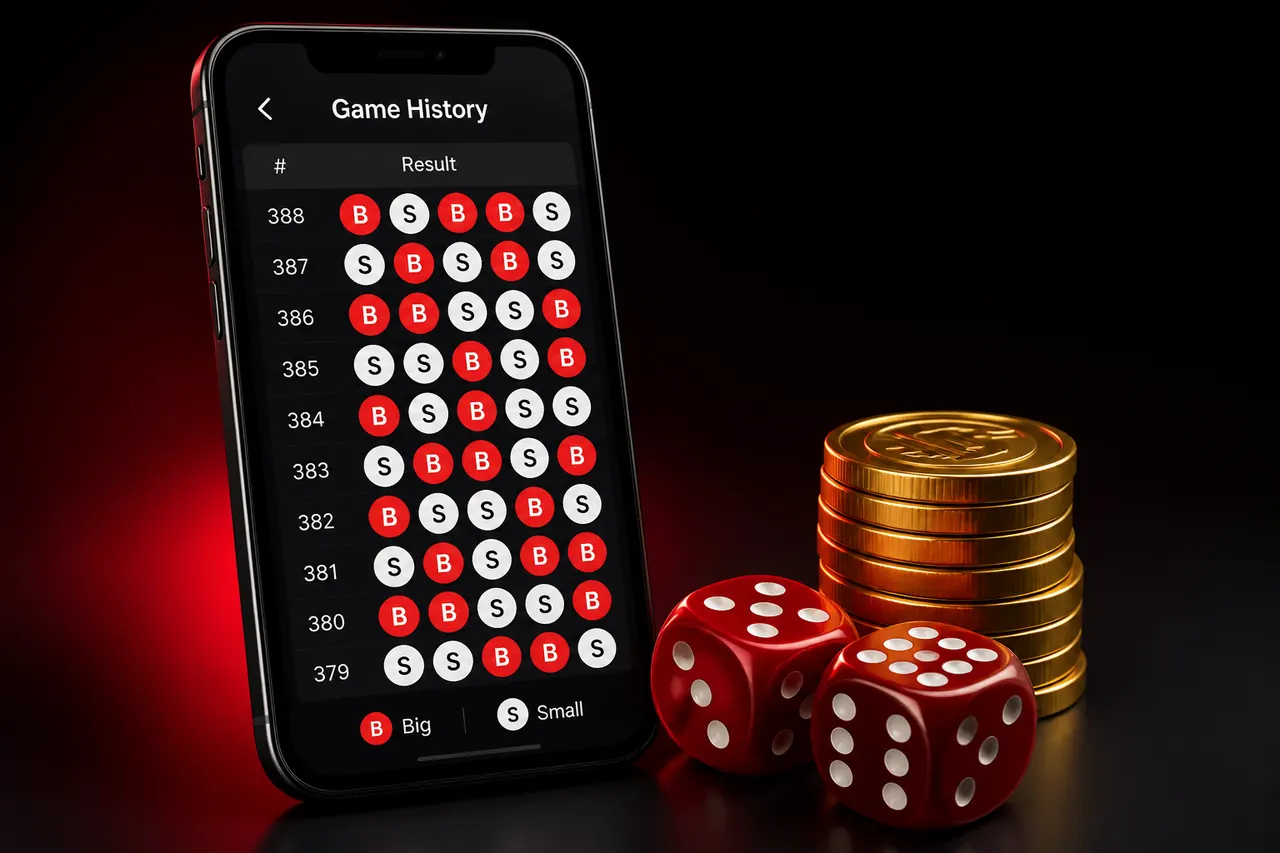
> Each round is independent. A long Small run does not force Big next — in digit rooms or 3-dice tables.
big small prediction guide
Know which strip you are reading
- WinGo-style: digits plus Big/Small tags for 0–4 / 5–9
- Casino Royale demo: markers for sums 3–10 / 11–18 across a long tracker (often ~100 rounds)
Misreading the strip format invents fake “systems”. Confirm the map with how to play before you take notes.
big small prediction guide
Training use: the 20-round review
After each block of 20 rounds, write only four fields:
- BSide you chose
- SOne-line reason (timing, limit rule, skip)
- BStake vs plan
- SResult
Then score process, not ego: late entries, map mix-ups, stake jumps after losses. That is prediction-as-training. Selling “next colour locked from strip” is not.
big small prediction guide
What history is good for
- Catching memory bias (“I was unlucky all night” vs actual log)
- Seeing whether you break stop rules during streaks
- Comparing calm blocks vs tilt blocks on demo
big small prediction guide
What history cannot do
No strip reveals a guaranteed next outcome. Random sequences produce clusters without a hidden signal. Read streaks and random rounds when a pattern feels “obvious”.
big small prediction guide
India search trap: “history + sure shot today”
Queries that glue history to certainty usually feed signal and hack funnels. Keep history for notes. Route certainty claims to hack, telegram signals, and live today.
big small prediction guide
Pair with a calculator or tool
Use calculator for exposure totals and prediction tool framing for trackers. If a “tool online” promises fixed accuracy, treat it as marketing — prediction tools education.
FAQ
Can I predict the exact next result from history?
No.
Why do streaks look predictable on charts?
Brains prefer patterns, even inside random data.
How many rounds should I review at once?
Fixed samples of 20–30 rounds keep reviews calmer.
Should I pay for history-based signal groups?
No. Most sell confidence, not verified edge.
Is strip reading part of training or predicting?
Training — when you log behaviour. Predicting — when you claim certainty. Only the first belongs here.